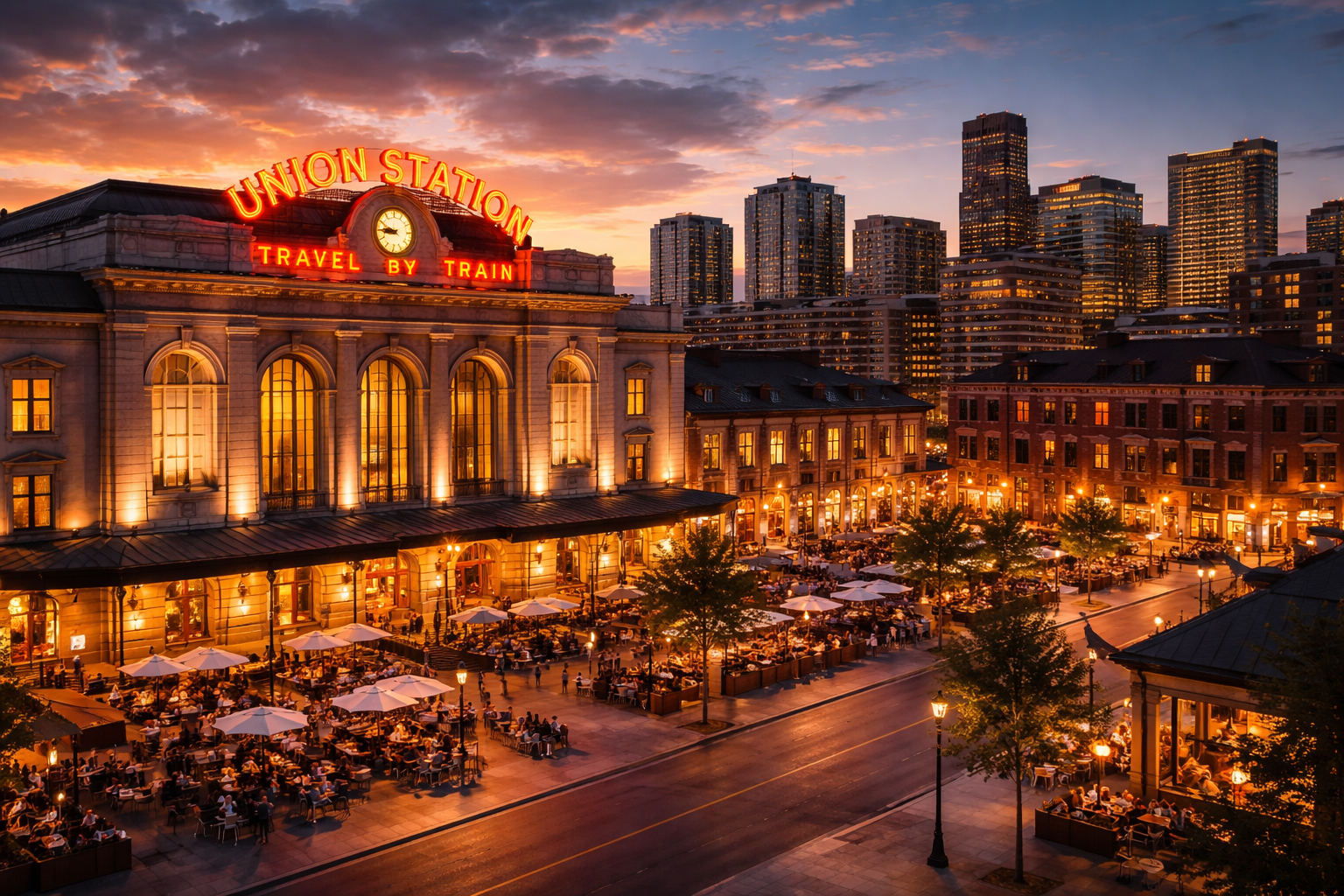
Denver Union Station is one of the rare places where a city still knows how to make arrival feel like an event.
In daylight, the station is handsome enough. Its Beaux-Arts confidence, long civic memory, and ongoing usefulness as a transportation hub already make it more than a preserved shell. But in evening light, the place finds its true register. The hall glows. Movement slows. A drink begins to feel properly timed. Dinner no longer seems like a separate plan but like the natural continuation of the building’s larger purpose: bringing people together in public with some degree of style. Denver Union Station calls itself a beloved landmark in the heart of LoDo and a celebrated destination for gathering, dining, shopping, and staying the night, and that description is unusually accurate. :contentReference[oaicite:1]{index=1}
Union Station works because it makes hospitality feel civic.
That is what makes the building so important to Denver now. It is not merely a pretty station with a few good restaurants attached. It is one of the places where the city learned how to host itself again. Opened in 1881, rebuilt in 1914, and reimagined in 2014, the station carries enough history to feel anchored and enough present-day life to avoid becoming a monument to its own restoration. :contentReference[oaicite:2]{index=2}
The Great Hall as Denver’s living room
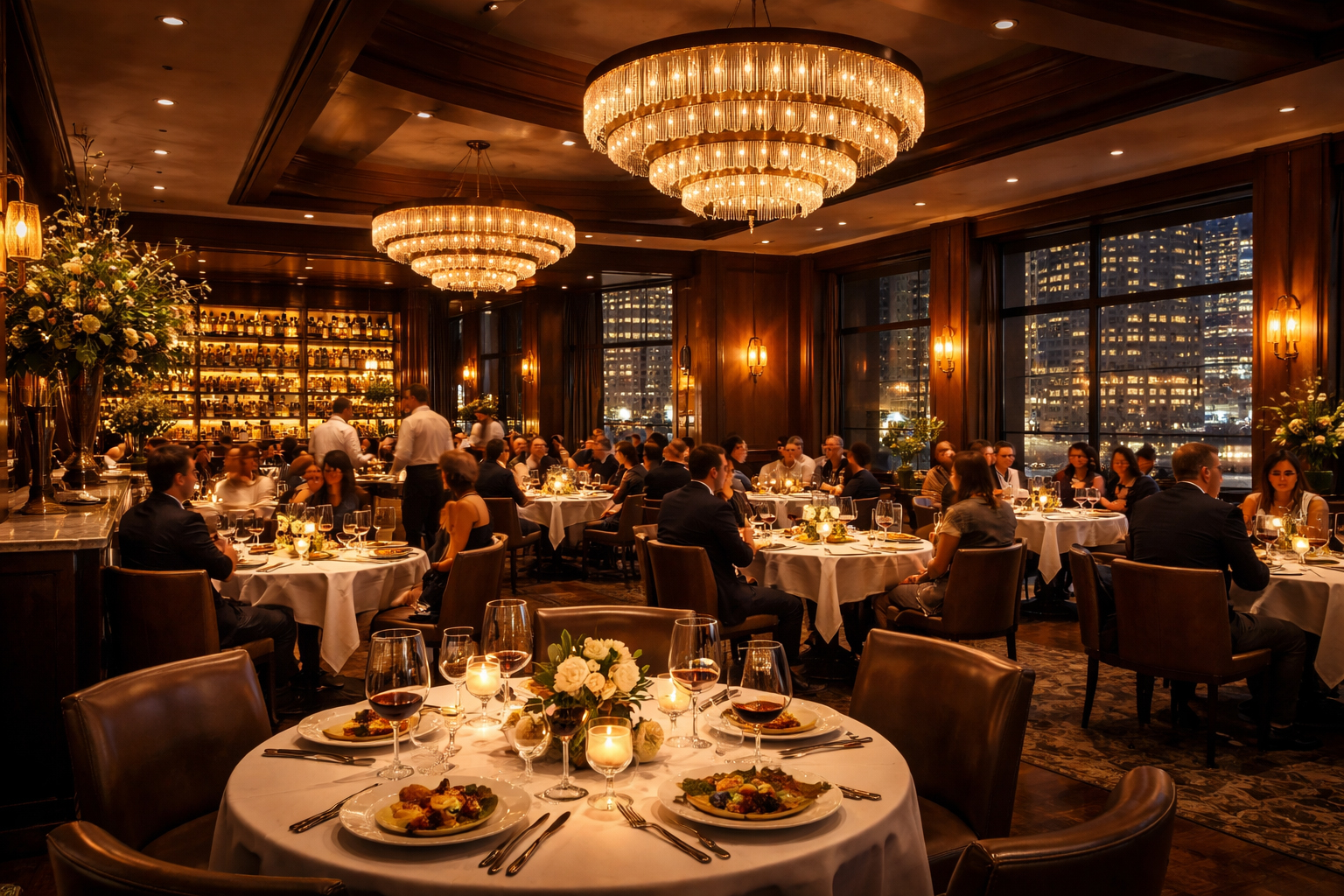
The Great Hall is the center of the mood. It is not only a passage space. It is a room in the old, serious sense of the word: a place where people sit, gather, watch, drift, order, arrive, wait, and let the city happen around them. This public softness is part of the station’s genius. Travel hubs are usually designed to push people onward. Union Station, at its best, persuades them to remain a little. :contentReference[oaicite:3]{index=3}
This is also why evening matters so much here. By then, the building has already completed its daytime work. What remains is atmosphere. The city’s energy starts to collect inside the hall differently. You sense the hotel above. You sense dinner reservations near at hand. You sense the tracks and transportation just beyond the walls, but the mood is no longer about departure. It is about inhabiting the station as a social place. Denver’s greatest destination is not a bad phrase for it at all. :contentReference[oaicite:4]{index=4}
The Crawford Hotel, located on the station’s upper floors, matters greatly to this feeling. It presents itself as a historic Union Station hotel and describes itself as connecting guests to the city’s living history and bold future from the heart of downtown. That phrasing might sound grand elsewhere, but inside Union Station it fits. A hotel above a great civic room changes the meaning of the whole building. It makes the station feel not only active but inhabited. :contentReference[oaicite:5]{index=5}
The rooms around the hall
A great hall needs good adjoining rooms, and Union Station has become one of Denver’s strongest dining clusters because the surrounding venues understand the building they are part of. Tavernetta, at 1889 Sixteenth Street, gives the station district one of its most polished tables. Its exact address and directness of tone matter: the restaurant sits close enough to the station that the hall still feels part of the evening. Mercantile, at 1701 Wynkoop Street, Suite 155, works from inside the station itself, folding breakfast, lunch, coffee, and dinner into the daily social circulation of the building. Ultreia, in Denver Union Station at 1701 Wynkoop, Suite 125, adds another current altogether — bright, convivial, Iberian, and unmistakably social. :contentReference[oaicite:6]{index=6}
What these rooms share is context. None of them has to create atmosphere from nothing because the station has already begun the work. The great advantage of dining here is that the meal starts before you sit down. It begins when you enter the building, see the hall, feel the evening tone, and realize that the district outside is ready to extend the experience. That is why Union Station feels larger than a restaurant row. It is a complete evening composition. :contentReference[oaicite:7]{index=7}
The best Union Station dinner is never only about the plate. It is also about the building, the hour, and the sense that the city has gathered itself correctly.
Even the simpler drinking addresses help complete the picture. Terminal Bar, in the Great Hall at 1701 Wynkoop Street, stays open daily and turns the hall itself into a place for a more casual glass, a pause before dinner, or a last drink before stepping back into LoDo. The building can host polish, but it also knows how to host ease. :contentReference[oaicite:8]{index=8}
The short walk beyond the doors
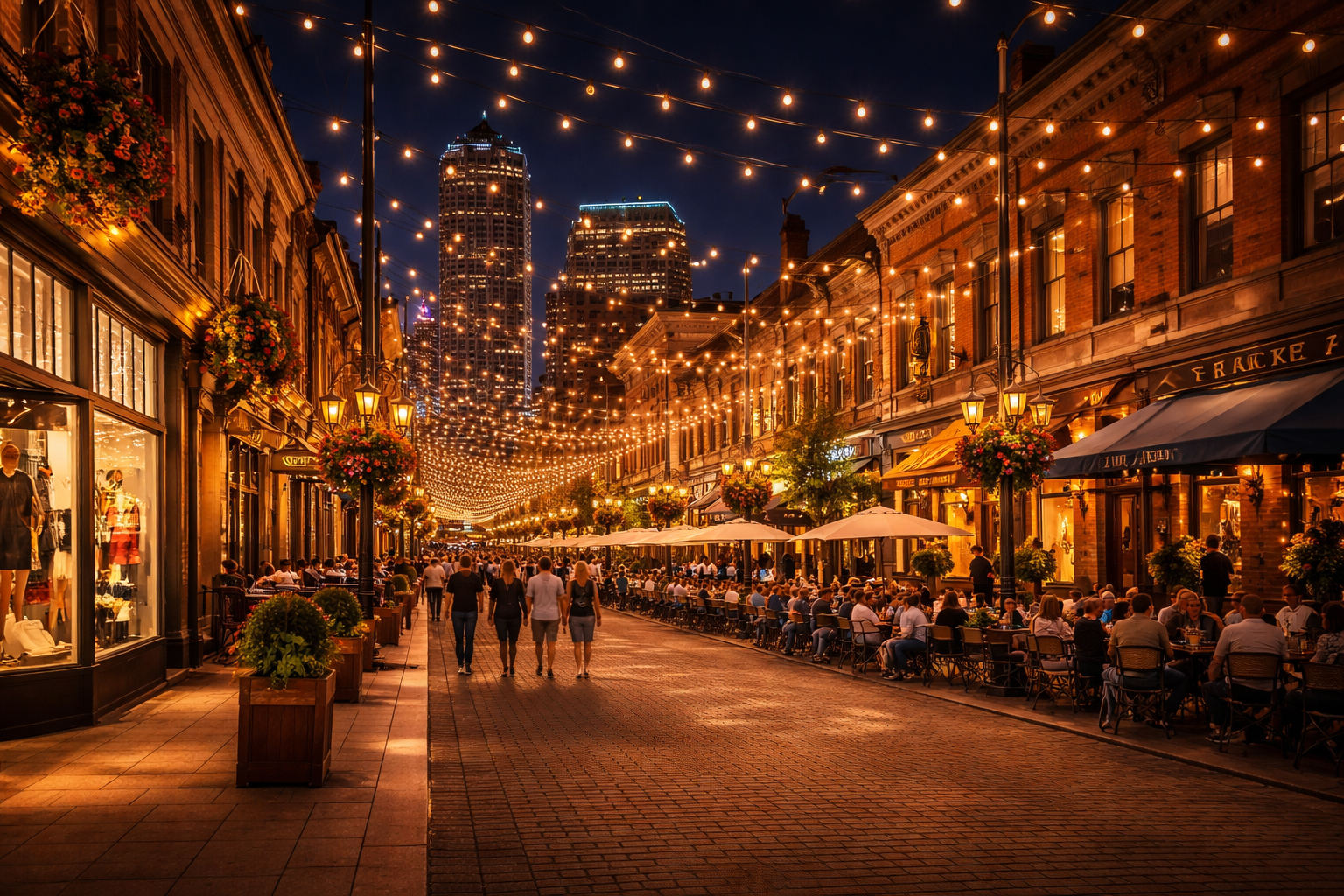
Another reason Union Station succeeds in evening light is that the district around it knows how to continue the mood. The station is not isolated. It sits in LoDo, close to hotels, bars, and walkable downtown streets. A person can dine in or near the station, pause in the hall, then keep moving into the night without feeling that the evening has broken in half. This continuity is one of the best measures of a real urban district. :contentReference[oaicite:9]{index=9}
The Crawford Hotel makes one kind of continuation possible: upstairs, inward, more intimate. The streets around Wynkoop make another possible: outward into downtown, under city light, still within the station’s gravitational field. Either path works because Union Station has already done the hardest thing. It has created a public setting worthy of extension. :contentReference[oaicite:10]{index=10}
This is why Union Station matters so much to Denver’s identity now. It is one of the places where the city learned that hospitality can be civic rather than merely commercial. That lesson has consequences beyond the building itself. It helps explain why Denver now feels more fluent at dinner, more convincing after dark, and more comfortable with the idea that a transportation landmark can also be one of the city’s most elegant social rooms. :contentReference[oaicite:11]{index=11}
In evening light, Union Station becomes more than a building. It becomes proof that Denver knows how to turn arrival into atmosphere.