Some streets are built for traffic. Some are built for shopping. A rare few are built for mood.
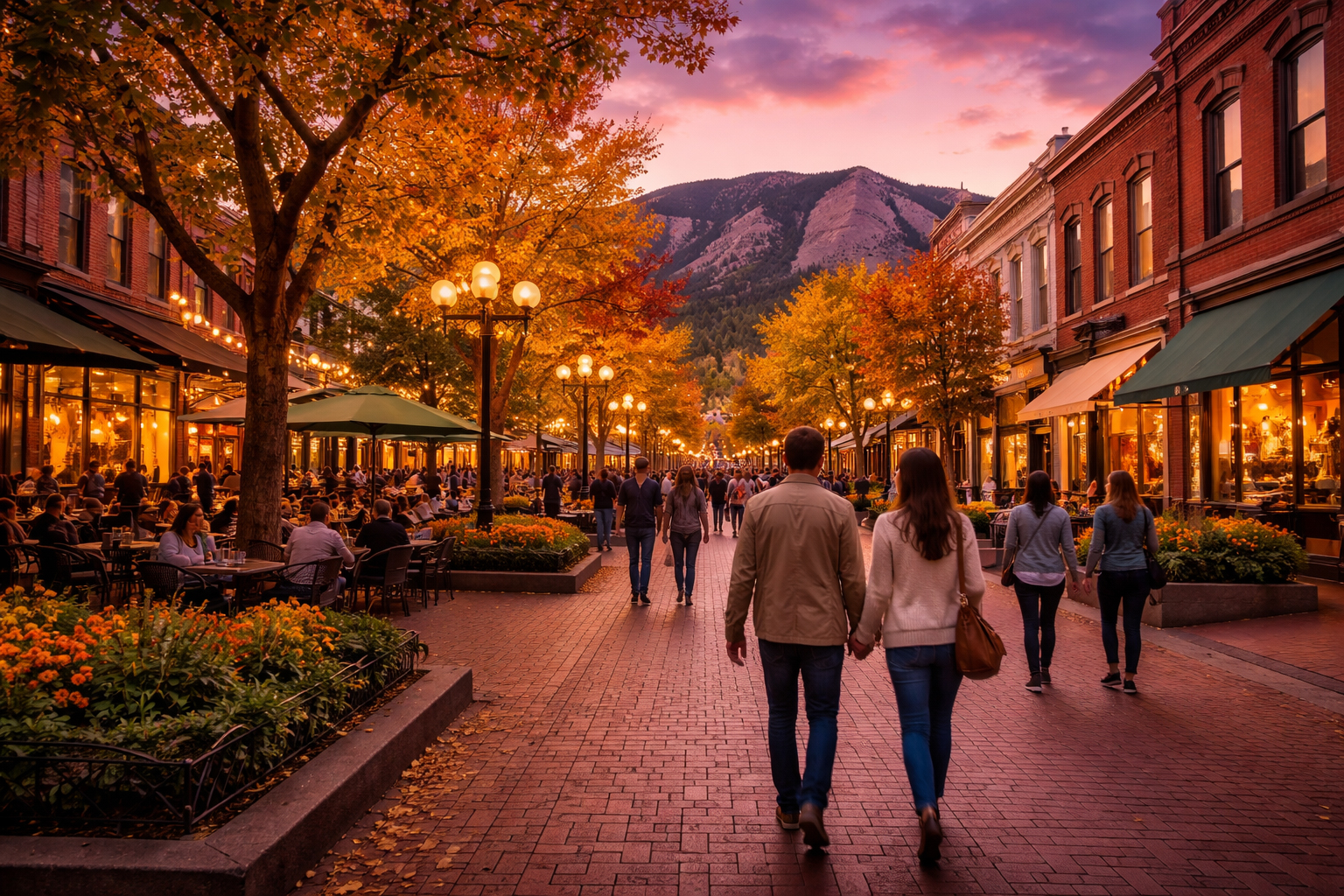
Pearl Street belongs to that last category. It does not ask to be hurried through. It is one of those places where the act of walking stops feeling like transition and becomes the event itself. You notice the light first. Then the width of the bricks. Then the musicians and performers. Then the fact that people seem to be participating in the day rather than merely getting through it. The Flatirons are still somewhere in the back of the mind, even when they are not directly in view. That changes the way a city street behaves.
This is why Pearl Street matters so much to Boulder’s identity. It is not simply a downtown amenity or a successful pedestrian mall. It is one of the city’s central arguments about how life should feel. Public space should not only be efficient. It should be pleasurable. It should allow for drift, for conversation, for coffee that turns into an extra half hour, for the accidental discovery of a table, a shop window, a musician, a bookstore, or a late-afternoon mood that makes the city feel better than the plan you brought into it.
Pearl Street succeeds because it makes ordinary public life feel slightly more beautiful than expected.
That beauty is not monumental. Boulder is too intelligent a city for that kind of self-importance. Instead, the beauty is civic and walkable. Trees, benches, storefronts, brick, open sky, mountain light, a little performance, a little appetite, and enough room for people to occupy the street without defending themselves against it. That is not accidental. It is design, but it is also temperament. Boulder has long wanted to prove that public life can be both lively and breathable. Pearl Street is where it proves it daily.
A street that gives the day structure
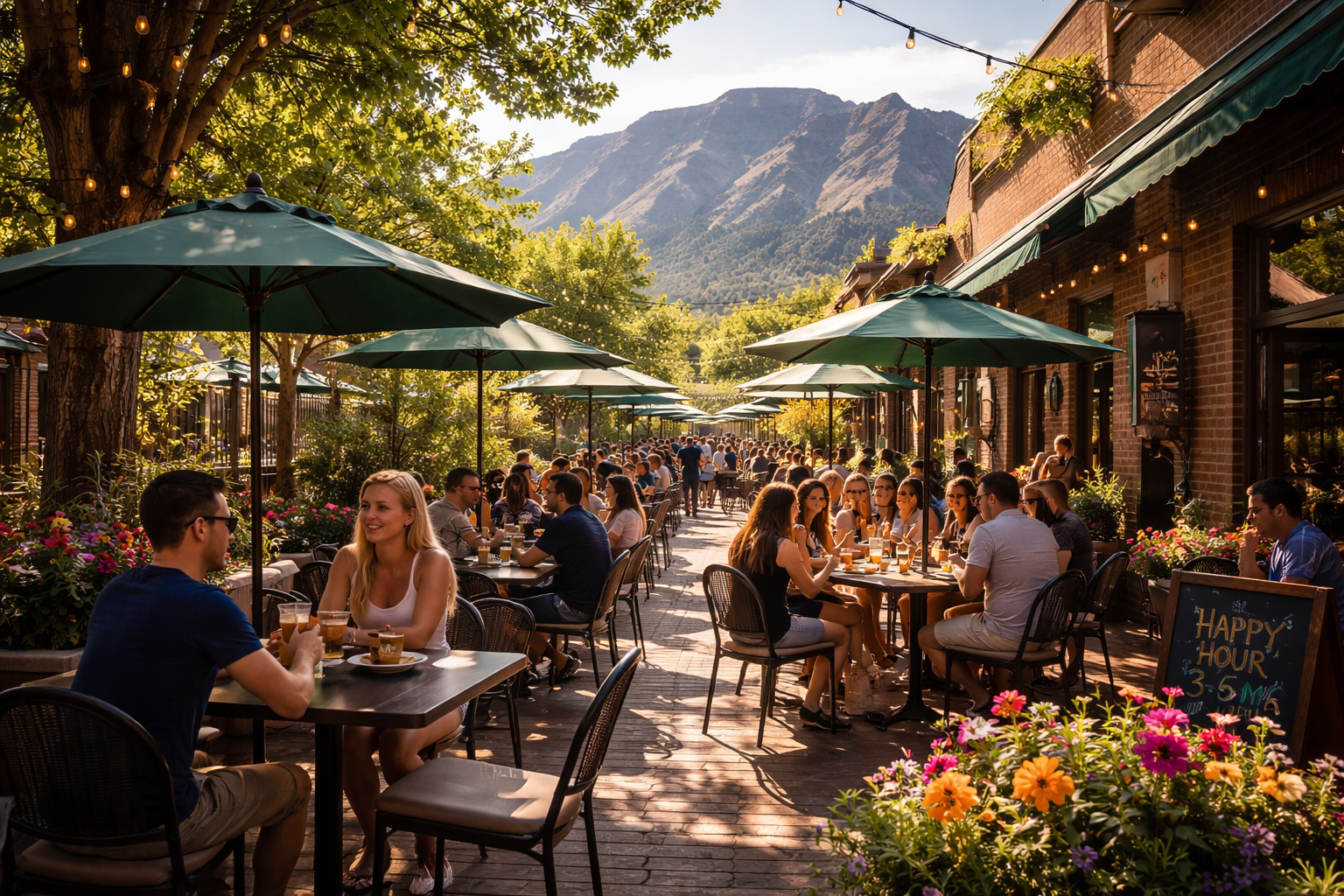
One of the quiet geniuses of Pearl Street is that it gives shape to a day without forcing one. A traveler can start with tea, drift toward lunch, stop inside a hotel lobby, continue into the late afternoon, and end with dinner or wine without ever feeling that the district has changed character dramatically. It remains itself. The mood ripens rather than resets.
This is why the best way to enjoy Pearl Street is not to attack it as an itinerary. The street is stronger as sequence than as checklist. Begin at the western end and let the blocks pull you forward. Or begin with the Teahouse and move inward toward the denser heart of downtown. Or start from Hotel Boulderado, where the city still carries a little historic elegance, and let that elegance dissolve naturally into the more public and democratic pleasure of the mall. Any of these approaches work because the street rewards continuation.
For visitors, this means Boulder offers a kind of urban travel experience that many American cities have forgotten how to provide. You can walk with no immediate task and still feel that the city is giving you something substantial. Not spectacle, perhaps, but calibration. A person begins to breathe at the pace of the street.
In most places, walking is what happens between the meaningful parts of the day. On Pearl Street, walking is the meaningful part.
The rooms that make the walk richer
Great walking streets need good rooms around them. Otherwise the walk never gathers enough shape to become memory. Pearl Street is fortunate in this regard. Hotel Boulderado remains one of the clearest ways to understand how Boulder’s downtown acquired grace before it acquired branding. Historic without becoming dusty, central without becoming generic, it gives the district a sense of rootedness. A stay there makes Pearl Street feel less like a pleasant district and more like part of a complete urban composition.
Frasca Food and Wine supplies another dimension entirely: seriousness at table. A district becomes more persuasive when it can support both casual drift and formal attention. Frasca gives Pearl Street some of its intellectual and culinary authority. It says that this street is not only for browsing and ice cream and a good afternoon. It is also for the fully composed dinner.
The Boulder Dushanbe Teahouse, meanwhile, reveals another side of the district’s charm. Walking should eventually lead to stillness. Tea, architecture, ornament, and a slightly improbable calm provide one of the city’s most memorable versions of that stillness. It is one of the places where Boulder’s public ease becomes almost ceremonial.
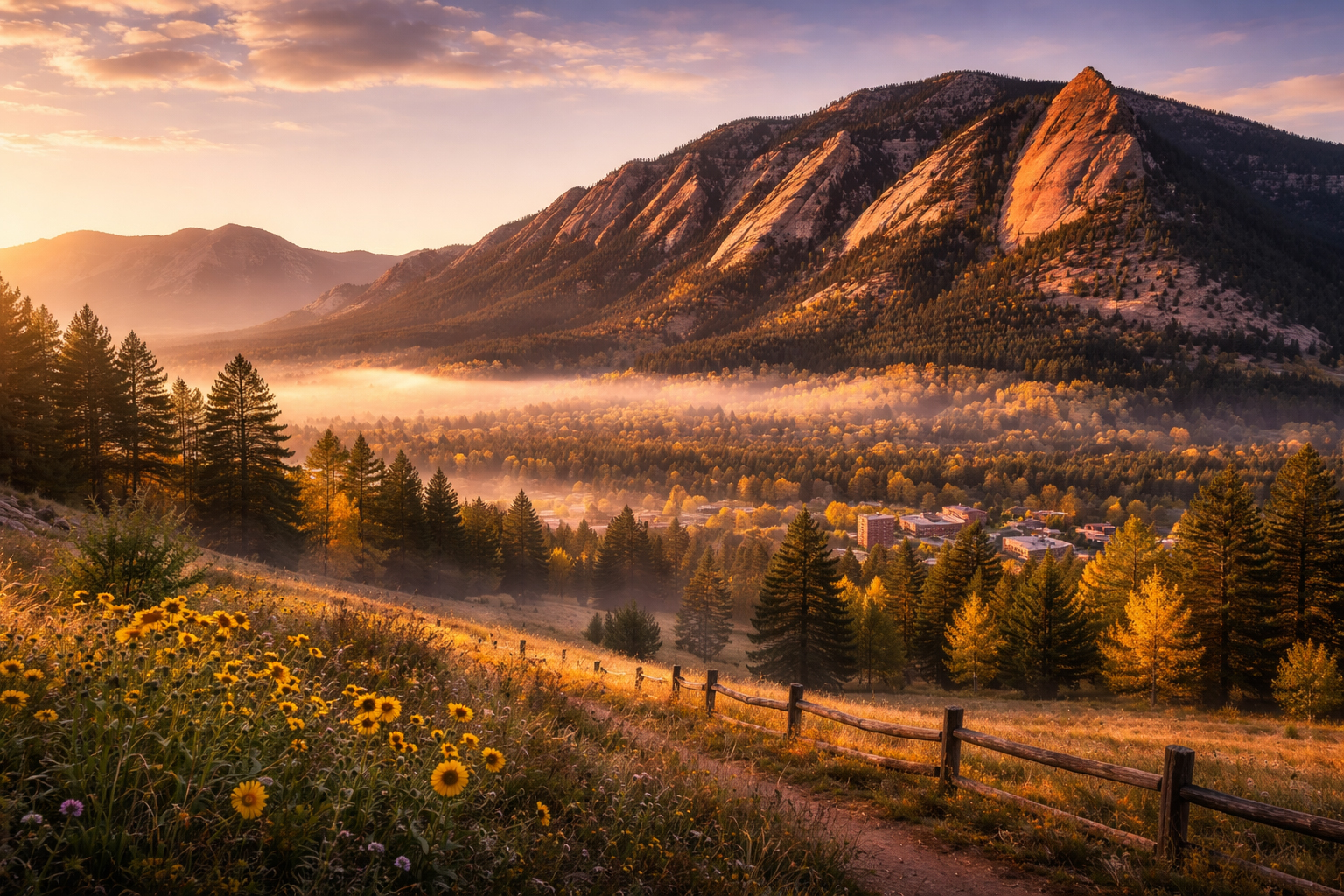
St Julien Hotel & Spa and Jill’s Restaurant & Bistro, slightly off the pedestrian center but deeply tied to downtown Boulder’s atmosphere, add another layer of pleasure: the mountain-facing polished room. They remind the visitor that Pearl Street does not float free from the larger Boulder setting. The walk always exists in relation to the foothills and the sky.
The democratic luxury
There is a kind of luxury that belongs only to cities: the luxury of being able to move through public life without strain. Pearl Street offers precisely this. The street is lively without being punishing. It is curated without becoming sterile. It is social without insisting on spectacle. It allows a traveler to occupy downtown Boulder in a way that feels both free and lightly held.
That is why the street feels restorative even though it is not explicitly sold as such. Many places now market wellness so aggressively that the word begins to lose moral credibility. Pearl Street does not need the word. It simply offers one of wellness’s oldest and best forms: a good walk in good air among other people who appear to be inhabiting the day rather than fighting it.
Perhaps that is the deepest pleasure of the street. It restores trust in the idea that a city can still be humane. Not perfect, not innocent, not free of money or aspiration or self-consciousness — Boulder has all of those things — but humane in its daily design. Pearl Street demonstrates that a public place can still serve attention rather than fracture it.
That is no small achievement. It is one of the reasons people leave Boulder remembering the feeling of the walk as clearly as any meal or hotel room. The street has done its work if a visitor can no longer separate the city from the pace at which they moved through it.
In the end, Pearl Street is a civic poem written in blocks. Boulder’s pleasure lies in the fact that you do not need to solve it. You only need to walk it well.