Some cities announce themselves with scale. Boulder does something subtler. It sharpens.
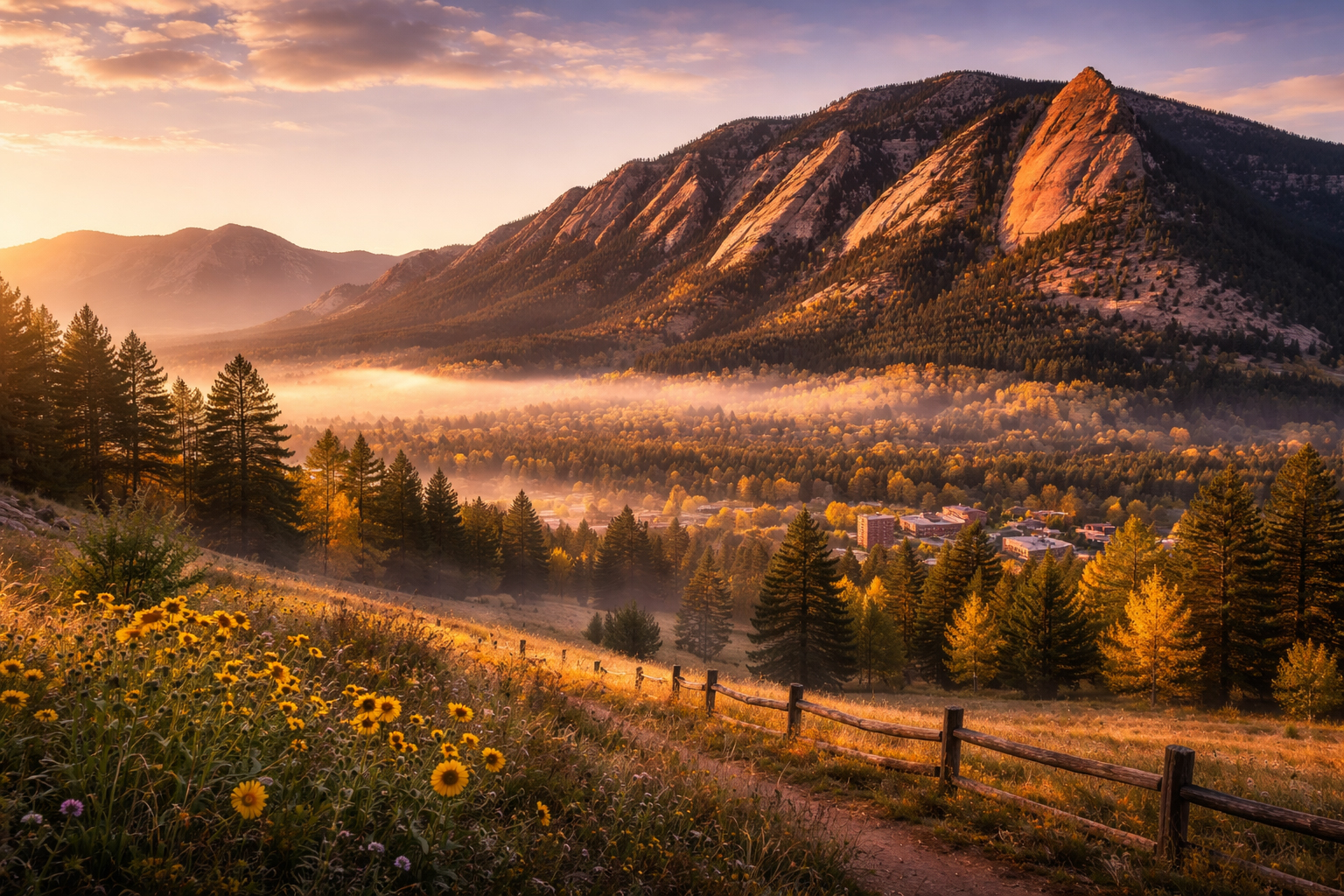
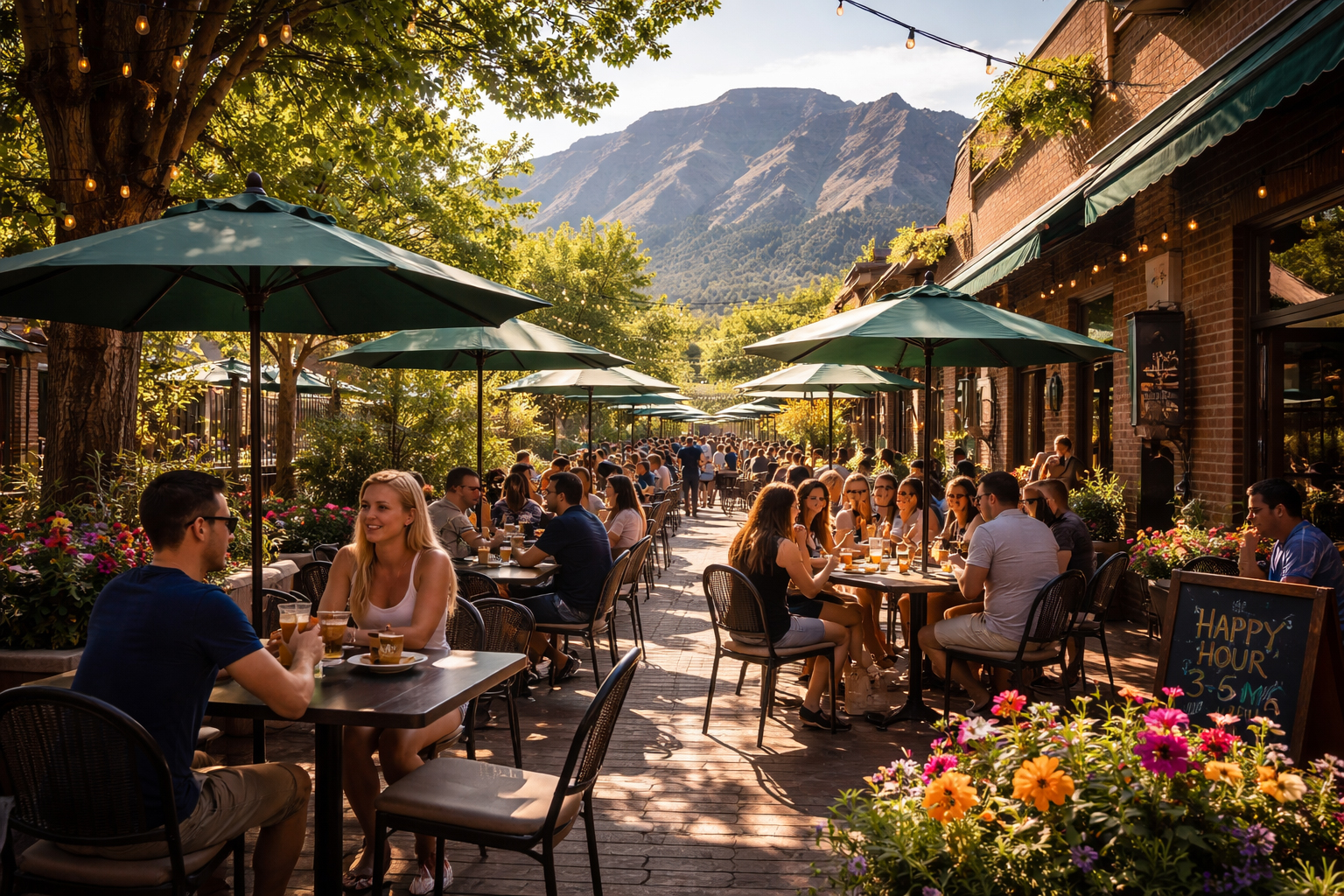
The first impression is often physical. The light feels cleaner than expected. The air seems to have been edited. The Flatirons rise behind daily life with a kind of stone authority that makes even ordinary errands look slightly more deliberate than they would elsewhere. Cafés open onto mountain views. Side streets feel exposed to weather in a way that keeps the city honest. People walk quickly, but not nervously. The place has energy, yet very little noise.
This is part of Boulder’s peculiar power. It does not perform itself like a metropolis, and it does not apologize for being clever. It is at once relaxed and exacting, visibly healthy and quietly competitive, beautiful enough to attract fantasy and serious enough to resist it. The city has become one of the most distinctive places in the American West because it makes something unusual feel natural: the coexistence of thought and landscape.
Boulder is one of the few cities where intelligence feels climatic — not only a matter of institutions, but part of the weather of the place.
That matters more than it sounds. Many cities are smart. Fewer feel built for intelligence. Boulder does. The streets, the campus, the footpaths, the laboratory culture, the ease of moving from research to espresso to mountain trail — all of it creates the impression of a city that expects ideas to remain physically close to life. That expectation is one of Boulder’s greatest achievements.
A city with a campus mind
Boulder’s modern identity is impossible to understand without its research culture. The University of Colorado Boulder does not simply sit inside the city as an isolated academic precinct. It radiates. The university gives Boulder one of its central habits of mind: curiosity organized into public life.
That radiance is part of why Boulder feels different from a resort town and different from a standard college town. CU Boulder contributes science, engineering, entrepreneurship, design, and a recurring influx of people who arrive expecting that difficult questions belong here. Quantum research is a good example. In Boulder, quantum is not merely a buzzword floated above venture capital decks. It is part of a local ecosystem of faculty, institutes, startups, and translational ambition. That gives the city unusual credibility. One can feel the difference between a place that markets intelligence and a place that actually hosts it.
Yet CU Boulder is only part of the larger pattern. Boulder’s national laboratories matter just as much to the city’s atmosphere. Their presence changes the emotional scale of the place. Weather science, atmospheric science, standards work, telecommunications research, environmental measurement, Earth systems thinking — these are not decorative institutions. They have helped make Boulder into a western city where precision has civic prestige.
This may be the most refined version of western ambition. Earlier Coloradans came looking for ore, routes, or advantage. Boulder still attracts seekers, but they seek through instruments, models, experiments, code, measurement, and interpretation. The instinct is old. The methods are new.

The public life of a thoughtful city
A great many places with strong research institutions still fail to become memorable cities. Their smartness remains enclosed. Boulder escapes that trap because its intelligence spills outward into the ordinary pleasures of the day.
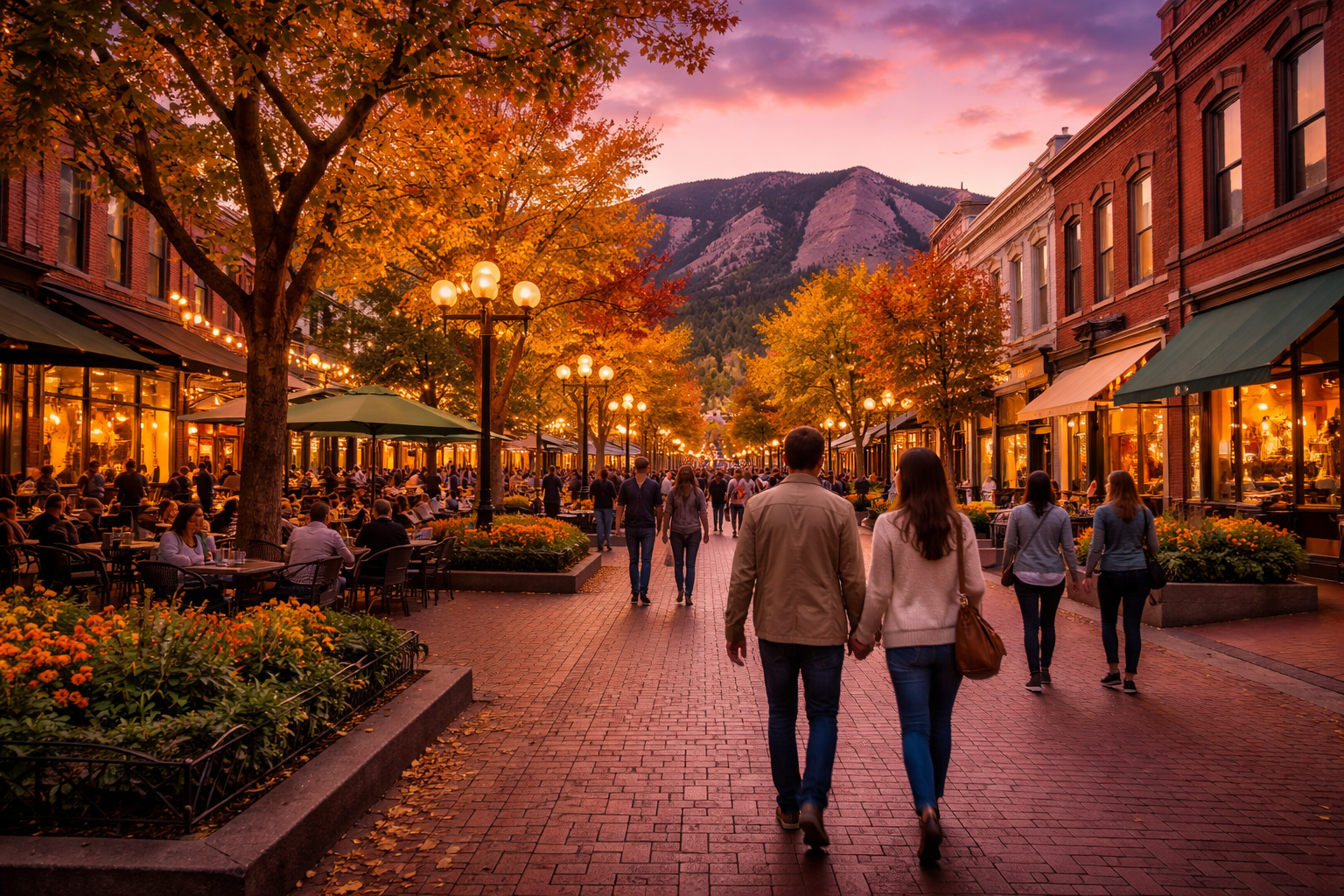
Pearl Street is one of the clearest examples. It is easy to reduce it to atmosphere — brick, trees, shopfronts, strolling, outdoor tables, mountain air. But its deeper importance lies in what it proves. Boulder can make public life feel both pleasant and mentally awake. The promenade is not merely a shopping district. It is a stage for the local temperament: alert, social, curious, moderately stylish, never too hurried, and always faintly aware of the landscape pressing in from the west.
That is what separates Boulder from cities that are merely affluent or merely picturesque. Its livability is not passive. It is intellectually inhabited. People do not only consume Boulder. They interpret it, discuss it, refine it, measure it against ideals of environment, technology, fairness, health, education, mobility, and the quality of time. Even the casual visitor can sense that this is a place where opinions are exercised like muscles.
Boulder is not a city that relaxes by becoming less itself. It relaxes by becoming more fully itself in public.
This is one reason the city has such a strong appeal to travelers who want more than scenery. The mountains are there, yes, and they are real enough to dominate every postcard. But Boulder offers another pleasure too: the sensation that modern life might be conducted with more intelligence, more beauty, and more oxygen than usual.
The laboratories behind the lifestyle
Boulder’s polished surface can mislead outsiders into thinking the city is mainly a lifestyle brand with excellent mountain access. That is too shallow. The better truth is that Boulder’s lifestyle is partly an effect of the institutions behind it.
The presence of NOAA, NSF NCAR, NIST, ITS, CIRES, and university research culture gives the city an unusual density of people whose working lives depend on accuracy. They forecast, model, measure, calibrate, test, interpret, and publish. This quietly shapes the city’s values. It helps explain why Boulder can feel simultaneously idealistic and exacting. People are not only outdoorsy here. Many of them are professionally acquainted with consequence.
Weather, climate, standards, air quality, space environment, telecommunications, instrumentation, quantum systems, entrepreneurship — these are not random sectors scattered in a pretty setting. They form a worldview. Boulder is one of the places in the American West where the frontier became an argument for deeper understanding instead of mere conquest.
That makes the city particularly important to Colorado’s future. If Denver often serves as the state’s public face, Boulder serves as one of its more disciplined minds. It demonstrates that western identity does not have to choose between nature and sophistication, or between trailhead culture and scientific seriousness. In Boulder, those pairs belong to the same sentence.
The city that keeps the horizon close
Perhaps that is the deepest reason Boulder stays in memory. It keeps the horizon close.
The phrase works literally, because the mountains never let you forget where you are. But it also works intellectually. Boulder encourages a certain relation to the future. It asks residents and visitors alike to imagine improvement not as abstraction, but as something that should still make sense in daylight, in public, in the presence of actual land.
This is why Boulder matters so much inside the larger story of Colorado. The state’s future cannot be built only on grandeur, or only on growth, or only on heritage. It must also be built on intelligence made livable. Boulder is one of the places where that experiment is already visible.
It is not perfect. No city that thinks this much ever is. Boulder can be self-conscious, expensive, moralizing, overconfident in its own disciplines, and occasionally too pleased with its own virtues. But those flaws are inseparable from the ambition that made the city matter. Better a city that risks earnestness than one that never learns to care what kind of place it is becoming.
In the end, Boulder does not feel important because it is fashionable, fit, scenic, or highly educated, though it is all of those things. It feels important because it proposes a version of the West in which thought is not a retreat from nature, but a way of deserving it.
That is why Boulder feels like an intelligent frontier.
Not a frontier of noise, but of calibration. Not a frontier of swagger, but of standards. Not a frontier that has forgotten the mountains, but one that keeps asking what sort of future can be built honestly in their sight.